
Drug Catalog - Product Detail
NALTREXONE HCL TAB 50MG 30CT
| NDC | Mfr | Size | Str | Form |
|---|---|---|---|---|
| 00406-1170-03 | MALLINCKRODT PHARM | 30 | 50MG | TABLET |

PACKAGE FILES
Generic Name
NALTREXONE HYDROCHLORIDE
Substance Name
NALTREXONE HYDROCHLORIDE
Product Type
HUMAN PRESCRIPTION DRUG
Route
ORAL
Application Number
ANDA076264
Description
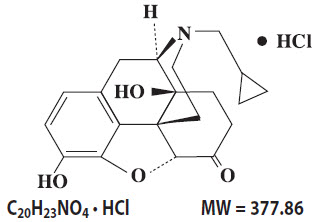
DESCRIPTION Naltrexone hydrochloride tablets, USP, an opioid antagonist, is a synthetic congener of oxymorphone with no opioid agonist properties. Naltrexone differs in structure from oxymorphone in that the methyl group on the nitrogen atom is replaced by a cyclopropylmethyl group. Naltrexone hydrochloride is also related to the potent opioid antagonist, naloxone, or n-allylnoroxymorphone. Naltrexone hydrochloride Naltrexone hydrochloride is a white or almost white powder. The hydrochloride salt is freely soluble in water. Naltrexone hydrochloride tablets, USP are available as film-coated tablets containing 50 mg of naltrexone hydrochloride. Naltrexone Hydrochloride Tablets, USP also contain: crospovidone, hydroxypropyl methylcellulose, lactose monohydrate, magnesium stearate, microcrystalline cellulose, polyethylene glycol, polysorbate 80, silicon dioxide, titanium dioxide, yellow iron oxide and red iron oxide. Structural Formula
How Supplied
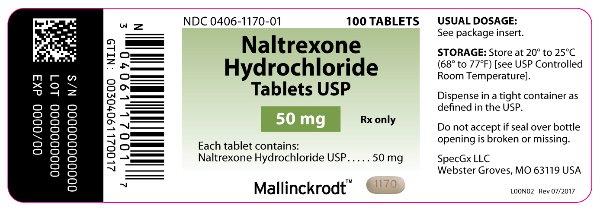
HOW SUPPLIED Naltrexone Hydrochloride Tablets, USP 50 mg are available as a yellow film coated capsule-shaped tablet with a convex surface, debossed with a number “50” and a full bisect in between the 5 and 0 on one side and “1170” on the other side. Bottles of 30……………NDC 0406-1170-03 Bottles of 100…………..NDC 0406-1170-01 Store at 20° to 25°C (68° to 77°F); excursions permitted to 15° to 30°C (59° to 86°F) [see USP Controlled Room Temperature]. Dispense in a tight container. © 2026 Par Health, Inc. or one of its affiliates. Manufactured for: SpecGx LLC Webster Groves, MO 63119 USA Revised: 05/2026 Par Health™
Indications & Usage
INDICATIONS AND USAGE Naltrexone Hydrochloride Tablets, USP are indicated in the treatment of alcohol dependence and for the blockade of the effects of exogenously administered opioids. Naltrexone Hydrochloride Tablets, USP have not been shown to provide any therapeutic benefit except as part of an appropriate plan of management for the addictions.
Dosage and Administration
DOSAGE AND ADMINISTRATION To reduce the risk of precipitated withdrawal in patients dependent on opioids, or exacerbation of a preexisting subclinical withdrawal syndrome, opioid-dependent patients, including those being treated for alcohol dependence, should be opioid-free (including tramadol) before starting naltrexone hydrochloride tablets treatment. An opioid-free interval of a minimum of 7 to 10 days is recommended for patients previously dependent on short-acting opioids. Patient Access to an Opioid Overdose Reversal Agent for the Emergency Treatment of Opioid Overdose When initiating and renewing treatment with naltrexone hydrochloride, inform patients and caregivers about opioid overdose reversal agents (e.g., naloxone, nalmefene) and discuss the importance of having access to an opioid overdose reversal agent. Because patients being treated for opioid use disorder have the potential for relapse, putting them at risk for opioid overdose after naltrexone hydrochloride treatment is discontinued, or after a dose of naltrexone hydrochloride is missed, strongly consider recommending or prescribing an overdose reversal agent naloxone for the emergency treatment of opioid overdose (see WARNINGS ). Discuss the options for obtaining an opioid overdose reversal agent (e.g., prescription, over-the-counter (some products), or as part of a community-based program) (see WARNINGS ). There are important differences among the opioid overdose reversal agents, such as route of administration, product strength, approved patient age range, and pharmacokinetics. Be familiar with these differences, as outlined in the approved labeling for those products, prior to recommending or prescribing such an agent. Switching from Buprenorphine, Buprenorphine/Naloxone, or Methadone There are no systematically collected data that specifically address the switch from buprenorphine or methadone to naltrexone hydrochloride tablets; however, review of postmarketing case reports have indicated that some patients may experience severe manifestations of precipitated withdrawal when being switched from opioid agonist therapy to opioid antagonist therapy (see WARNINGS ). Patients transitioning from buprenorphine or methadone may be vulnerable to precipitation of withdrawal symptoms for as long as 2 weeks. Healthcare providers should be prepared to manage withdrawal symptomatically with non-opioid medications. Treatment of Alcoholism A dose of 50 mg once daily is recommended for most patients. The placebo-controlled studies that demonstrated the efficacy of naltrexone hydrochloride tablets as an adjunctive treatment of alcoholism used a dose regimen of naltrexone hydrochloride tablets 50 mg once daily for up to 12 weeks. Other dose regimens or durations of therapy were not evaluated in these trials. Naltrexone hydrochloride tablets should be considered as only one of many factors determining the success of treatment of alcoholism. Factors associated with a good outcome in the clinical trials with naltrexone hydrochloride tablets were the type, intensity, and duration of treatment; appropriate management of comorbid conditions; use of community-based support groups; and good medication compliance. To achieve the best possible treatment outcome, appropriate compliance-enhancing techniques should be implemented for all components of the treatment program, especially medication compliance. Treatment of Opioid Dependence Treatment should be initiated with an initial dose of 25 mg of naltrexone hydrochloride tablets. If no withdrawal signs occur, the patient may be started on 50 mg a day thereafter. A dose of 50 mg once a day will produce adequate clinical blockade of the actions of parenterally administered opioids. As with many non-agonist treatments for addiction, naltrexone hydrochloride tablets are of proven value only when given as part of a comprehensive plan of management that includes some measure to ensure the patient takes the medication. Naloxone Challenge Test Clinicians are reminded that there is no completely reliable method for determining whether a patient has had an adequate opioid-free period. A naloxone challenge test may be helpful if there is any question of occult opioid dependence. If signs of opioid withdrawal are still observed following naloxone challenge, treatment with naltrexone hydrochloride tablets should not be attempted. The naloxone challenge can be repeated in 24 hours. The naloxone challenge test should not be performed in a patient showing clinical signs or symptoms of opioid withdrawal, or in a patient whose urine contains opioids. The naloxone challenge test may be administered by either the intravenous or subcutaneous routes. Intravenous Inject 0.2 mg naloxone. Observe for 30 seconds for signs or symptoms of withdrawal. If no evidence of withdrawal, inject 0.6 mg of naloxone. Observe for an additional 20 minutes. Subcutaneous Administer 0.8 mg naloxone. Observe for 20 minutes for signs or symptoms of withdrawal. Note: Individual patients, especially those with opioid dependence, may respond to lower doses of naloxone. In some cases, 0.1 mg intravenous naloxone has produced a diagnostic response. Interpretation of the Challenge Monitor vital signs and observe the patient for signs and symptoms of opioid withdrawal. These may include, but are not limited to: nausea, vomiting, dysphoria, yawning, sweating, tearing, rhinorrhea, stuffy nose, craving for opioids, poor appetite, abdominal cramps, sense of fear, skin erythema, disrupted sleep patterns, fidgeting, uneasiness, poor ability to focus, mental lapses, muscle aches or cramps, pupillary dilation, piloerection, fever, changes in blood pressure, pulse or temperature, anxiety, depression, irritability, backache, bone or joint pains, tremors, sensations of skin crawling or fasciculations. If signs or symptoms of withdrawal appear, the test is positive and no additional naloxone should be administered. Warning: If the test is positive, do NOT initiate naltrexone hydrochloride tablets therapy. Repeat the challenge in 24 hours. If the test is negative, naltrexone hydrochloride tablets therapy may be started if no other contraindications are present. If there is any doubt about the result of the test, hold naltrexone hydrochloride tablets and repeat the challenge in 24 hours. Alternative Dosing Schedules A flexible approach to a dosing regimen may need to be employed in cases of supervised administration. Thus, patients may receive 50 mg of naltrexone hydrochloride tablets every weekday with a 100 mg dose on Saturday, 100 mg every other day, or 150 mg every third day. The degree of blockade produced by naltrexone hydrochloride tablets may be reduced by these extended dosing intervals. There may be a higher risk of hepatocellular injury with single doses above 50 mg, and use of higher doses and extended dosing intervals should balance the possible risks against the probable benefits (see WARNINGS ). Patient Compliance Naltrexone hydrochloride tablets should be considered as only one of many factors determining the success of treatment. To achieve the best possible treatment outcome, appropriate compliance-enhancing techniques should be implemented for all components of the treatment program, including medication compliance.