
Drug Catalog - Product Detail
ISOTRETINOIN (CLARAVIS) CP 10MG 3X10
| NDC | Mfr | Size | Str | Form |
|---|---|---|---|---|
| 00555-1054-86 | TEVA PHARMACEUTICALS USA | 30 | 10MG | CAPSULE |

PACKAGE FILES
Generic Name
ISOTRETINOIN
Substance Name
ISOTRETINOIN
Product Type
HUMAN PRESCRIPTION DRUG
Route
ORAL
Application Number
ANDA076356
Description
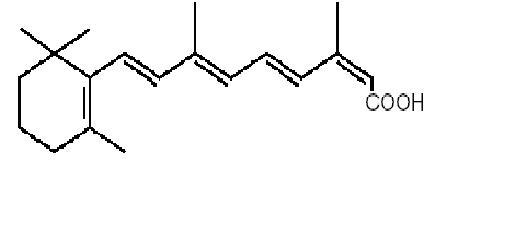
11 DESCRIPTION Isotretinoin, USP a retinoid, is available as Claravis ™ (isotretinoin capsules USP), in 10 mg, 20 mg, 30 mg and 40 mg hard gelatin capsules for oral administration. Chemically, isotretinoin is 13- cis -retinoic acid and is related to both retinoic acid and retinol (vitamin A). It is a yellow to orange crystalline powder with a molecular weight of 300.44. Isotretinoin has high lipophilicity. The structural formula is: Each capsule contains the following inactive ingredients: butylated hydroxyanisole, edetate disodium, gelatin, hydrogenated vegetable oil, polysorbate 80, soybean oil, titanium dioxide, white wax (beeswax), and vitamin E. In addition, the 10 mg capsule contains black iron oxide and FD&C yellow no. 6. The 20 mg capsule contains black iron oxide, red iron oxide and yellow iron oxide. The 30 mg capsule contains red iron oxide and yellow iron oxide. The 40 mg capsule contains FD&C yellow no. 6. The edible imprinting ink contains: 10 mg strength, D&C red no. 7 calcium lake, FD&C yellow no. 6 aluminum lake, propylene glycol, shellac glaze, and titanium dioxide; 20 mg strength, ammonium hydroxide, propylene glycol, shellac glaze, simethicone and titanium dioxide; 30 mg strength, D&C yellow no. 10 aluminum lake, FD&C blue no.1 aluminum lake, FD&C blue no. 2 aluminum lake, FD&C red no. 40 aluminum lake, iron oxide black, propylene glycol, and shellac glaze; 40 mg strength, ammonium hydroxide, iron oxide black, propylene glycol, and shellac glaze. Meets dissolution test 2. structure
How Supplied
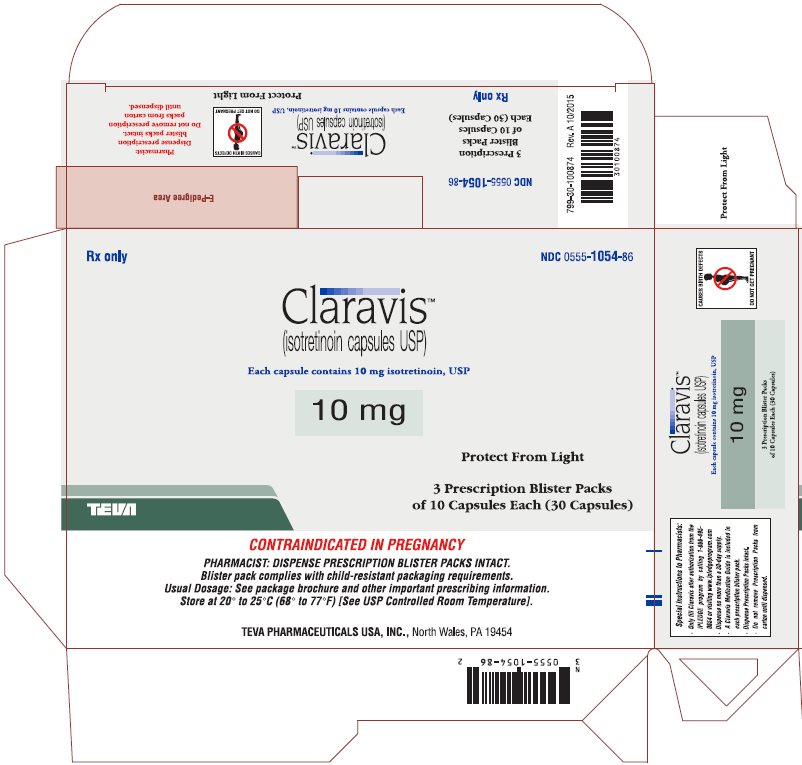
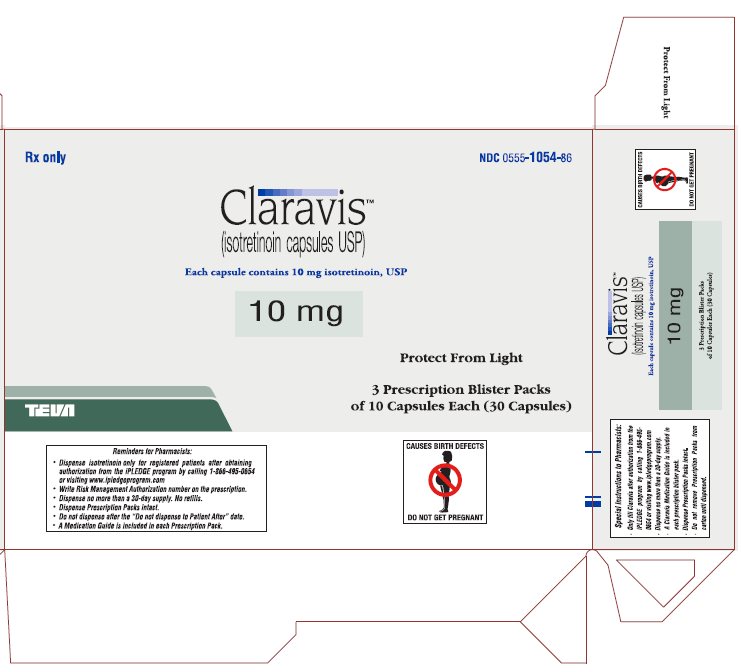
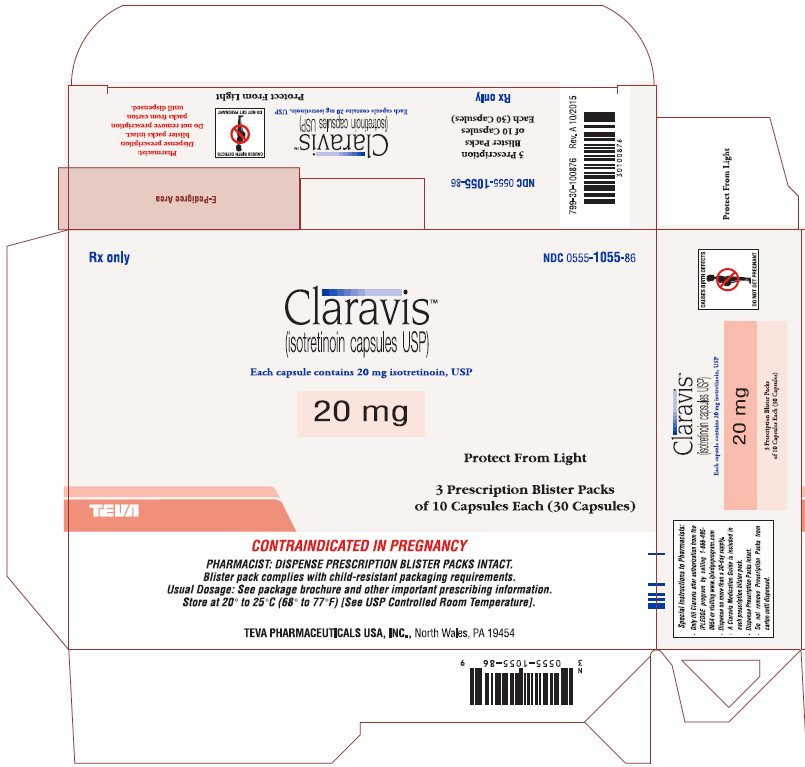
16 HOW SUPPLIED/STORAGE AND HANDLING Claravis ™ (isotretinoin capsules USP) is available as: 10 mg: Two-piece hard gelatin capsule with light gray opaque cap and light gray opaque body filled with yellow oily dispersion. Imprinted in red ink barr on one piece and 934 on the other piece. Available in cartons of 30 capsules containing 3 prescription blister packs of 10 capsules (NDC 0555-1054-86) and 100 capsules containing 10 prescription blister packs of 10 capsules (NDC 0555-1054-56). 20 mg: Two-piece hard gelatin capsule with brown opaque cap and brown opaque body filled with yellow oily dispersion. Imprinted in white ink barr on one piece and 935 on the other piece. Available in cartons of 30 capsules containing 3 prescription blister packs of 10 capsules (NDC 0555-1055-86) and 100 capsules containing 10 prescription blister packs of 10 capsules (NDC 0555-1055-56). 30 mg: Two-piece hard gelatin capsule with orange opaque cap and orange opaque body filled with yellow oily dispersion. Imprinted in black ink barr on one piece and 454 on the other piece. Available in cartons of 30 capsules containing 3 prescription blister packs of 10 capsules (NDC 0555-1056-86). 40 mg: Two-piece hard gelatin capsule with light orange opaque cap and light orange opaque body filled with yellow oily dispersion. Imprinted in black ink barr on one piece and 936 on the other piece. Available in cartons of 30 capsules containing 3 prescription blister packs of 10 capsules (NDC 0555-1057-86) and 100 capsules containing 10 prescription blister packs of 10 capsules (NDC 0555-1057-56). Store at 20° to 25°C (68° to 77°F) [See USP Controlled Room Temperature]. Protect from light. Keep this and all medications out of the reach of children.
Indications & Usage
1 INDICATIONS AND USAGE Claravis ™ (isotretinoin capsules USP) is indicated for the treatment of severe recalcitrant nodular acne in non-pregnant patients 12 years of age and older with multiple inflammatory nodules with a diameter of 5 mm or greater. Because of significant adverse reactions associated with its use, Claravis is reserved for patients with severe nodular acne who are unresponsive to conventional therapy, including systemic antibiotics. Limitations of Use : If a second course of Claravis treatment is needed, it is not recommended before a two-month waiting period because the patient's acne may continue to improve following a 15 to 20-week course of treatment [see Dosage and Administration ( 2.2 )]. Claravis (isotretinoin capsules) is a retinoid indicated for the treatment of severe recalcitrant nodular acne in non-pregnant patients 12 years of age and older with multiple inflammatory nodules with a diameter of 5 mm or greater. Because of significant adverse reactions associated with its use, Claravis is reserved for patients with severe nodular acne who are unresponsive to conventional therapy, including systemic antibiotics. ( 1 ) Limitations of Use : If a second course of Claravis treatment is needed, it is not recommended before a two-month waiting period because the patient's acne may continue to improve following a 15 to 20-week course of treatment. ( 1 )
Dosage and Administration
2 DOSAGE AND ADMINISTRATION Evaluations Prior to Prescribing and Use of Claravis: In patients who can get pregnant, only prescribe Claravis after verification and documentation that they are not pregnant. See the Full Prescribing Information for the detailed requirements prior to prescribing Claravis ( 2.1 , 8.3 ) Complete the following laboratory tests in all patients: fasting lipid profile and liver function tests. ( 2.1 ) Recommended dosage is 0.5 to 1 mg/kg/day given in two divided doses with food for 15 to 20 weeks ( 2.2 ) Adult patients with very severe disease (scarring, trunk involvement) may increase dosage to 2 mg/kg/day in two divided doses with food. ( 2.1 ) Once daily dosing is not recommended. ( 2.2 ) If a dose is missed, just skip that dose. Do not take two doses at the same time. ( 2.2 ) See the Full Prescribing Information for the recommended duration of use ( 2.3 ) 2.1 Evaluations Prior to Prescribing and Use of Claravis In patients who can get pregnant, only prescribe Claravis after verification and documentation that they are not pregnant [see Contraindications ( 4 ) and Warnings and Precautions ( 5.1 , 5.2 )]. For the detailed requirements prior to prescribing Claravis, see Use in Specific Populations ( 8.3 )]. Prior to Claravis use in all patients, complete the following laboratory testing: A fasting lipid profile including triglycerides [see Warnings and Precautions ( 5.7 , 5.14 )] . Liver function tests [see Warnings and Precautions ( 5.9 , 5.14 )] . 2.2 Recommended Dosage The recommended dosage range for Claravis is 0.5 to 1 mg/kg/day given in two divided doses with food for 15 to 20 weeks (see Tables 1 and 2, respectively) [see Clinical Pharmacology ( 12.3 )] . Table 1: Claravis: Recommended Divided Doses (0.5 mg/kg/day dosage) Body Weight First Dose Second Dose 40 kg 10 mg 10 mg 50 kg 12.5 mg 12.5 mg 60 kg 15 mg 15 mg 70 kg 17.5 mg 17.5 mg 80 kg 20 mg 20 mg 90 kg 22.5 mg 22.5 mg 100 kg 25 mg 25 mg Table 2: Claravis: Recommended Divided Doses (1 mg/kg/day dosage) Body Weight First Dose Second Dose 40 kg 20 mg 20 mg 50 kg 25 mg 25 mg 60 kg 30 mg 30 mg 70 kg 35 mg 35 mg 80 kg 40 mg 40 mg 90 kg 45 mg 45 mg 100 kg 50 mg 50 mg To decrease the risk of esophageal irritation, instruct patients to swallow the capsules with a full glass of liquid. Swallow capsules whole. Do not split, crush, chew, or suck on the capsules. During treatment, the dosage may be adjusted according to response of the disease and/or adverse reactions, some of which may be dose-related. Adult patients whose disease is very severe with scarring or is primarily manifested on the trunk may require dosage adjustments up to 2 mg/kg/day for Claravis in divided doses with food, as tolerated (see Table 3). Table 3: Claravis: Recommended Divided Doses (2 mg/kg/day dosage) Body Weight First Dose Second Dose 40 kg 40 mg 40 mg 50 kg 50 mg 50 mg 60 kg 60 mg 60 mg 70 kg 70 mg 70 mg 80 kg 80 mg 80 mg 90 kg 90 mg 90 mg 100 kg 100 mg 100 mg The safety and effectiveness of once daily dosing with Claravis has not been established and is not recommended. If a dose of Claravis is missed, just skip that dose. Do not take two doses of Claravis at the same time. 2.3 Recommended Duration of Use A course of treatment is 15 to 20 weeks. If the total nodule count has been reduced by more than 70% prior to completing 15 to 20 weeks of treatment, may discontinue Claravis. After a period of 2 months or more off treatment, and if warranted by persistent or recurring severe nodular acne, may initiate a second course of Claravis in patients who have completed skeletal growth. The use of another course of Claravis treatment is not recommended before a two-month waiting period because the patient's acne may continue to improve after a 15 to 20-week course of treatment. The optimal interval before retreatment has not been defined for patients who have not completed skeletal growth. Long-term use of Claravis, even in low dosages, has not been studied, and is not recommended. The effect of long-term use of Claravis on bone loss is unknown [see Warnings and Precautions ( 5.11 )] .