
Drug Catalog - Product Detail
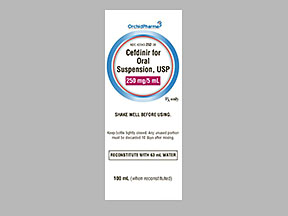
CEFDINIR PDR ORAL SOL 250MG/5ML 100ML
| NDC | Mfr | Size | Str | Form |
|---|---|---|---|---|
| 42043-0252-38 | ORCHIDPHARMA | 100 | 250MG/5ML | SUSPENSION |
Generic Name
Substance Name
Product Type
Route
Application Number
Description
DESCRIPTION Cefdinir for oral suspension, USP contains the active ingredient cefdinir monohydrate, an extended-spectrum, semisynthetic cephalosporin, for oral administration. Chemically, cefdinir is [6R-[6α, 7β (Z)]]-7-[[(2-amino-4-thiazolyl)-(hydroxyimino)acetyl]amino]-3-ethenyl-8-oxo-5-thia-1-azabicyclo[4.2.0]oct-2-ene-2-carboxylic acid. Cefdinir monohydrate is a white to slightly brownish-yellow solid. It is slightly soluble in dilute hydrochloric acid and sparingly soluble in 0.1M pH 7.0 phosphate buffer. The empirical formula is C 14 H 13 N 5 O 5 S 2 .H 2 O and the molecular weight is 413.47. Cefdinir monohydrate has the structural formula shown below: Cefdinir for oral suspension, USP after reconstitution, contains cefdinir USP equivalent to anhydrous cefdinir 125 mg per 5 mL or anhydrous cefdinir 250 mg per 5 mL and the following inactive ingredients: sucrose, citric acid (anhydrous), sodium citrate (anhydrous), sodium benzoate, xanthan gum, guar gum, strawberry flavor and cream vanilla flavor. structure
How Supplied
HOW SUPPLIED Cefdinir for Oral Suspension, USP: Off-White to pale yellow colored granular powder with characteristic flavour and gives cream colour to pale yellow coloured viscous suspension after reconstitution with water. Each 5 mL contains cefdinir USP equivalent to 125 mg or 250 mg anhydrous cefdinir after reconstitution. The powder is available as follows: 125 mg/5 mL 60 mL bottle per carton NDC 42043-251-67 100 mL bottle per carton NDC 42043-251-38 250 mg/5 mL 60 mL bottle per carton NDC 42043-252-67 100 mL bottle per carton NDC 42043-252-38 Store the unsuspended powder at 20° to 25° C (68° to 77° F) [See USP Controlled Room Temperature]. Once reconstituted, the oral suspension can be stored at controlled room temperature for 10 days.
Indications & Usage
INDICATIONS AND USAGE To reduce the development of drug-resistant bacteria and maintain the effectiveness of cefdinir and other antibacterial drugs, cefdinir should be used only to treat or prevent infections that are proven or strongly suspected to be caused by susceptible bacteria. When culture and susceptibility information are available, they should be considered in selecting or modifying antibacterial therapy. In the absence of such data, local epidemiology and susceptibility patterns may contribute to the empiric selection of therapy. Cefdinir for oral suspension is indicated for the treatment of patients with mild to moderate infections caused by susceptible strains of the designated microorganisms in the conditions listed below. Adults and Adolescents Community-Acquired Pneumonia caused by Haemophilus influenzae (including β-lactamase producing strains), Haemophilus parainfluenzae (including β-lactamase producing strains), Streptococcus pneumoniae (penicillin-susceptible strains only), and Moraxella catarrhalis (including β-lactamase producing strains) (see CLINICAL STUDIES ). Acute Exacerbations of Chronic Bronchitis caused by Haemophilus influenzae (including β-lactamase producing strains), Haemophilus parainfluenzae (including β-lactamase producing strains), Streptococcus pneumoniae (penicillin-susceptible strains only), and Moraxella catarrhalis (including β-lactamase producing strains). Acute Maxillary Sinusitis caused by Haemophilus influenzae (including β-lactamase producing strains), Streptococcus pneumoniae (penicillin-susceptible strains only), and Moraxella catarrhalis (including β-lactamase producing strains). NOTE: For information on use in pediatric patients, see Pediatric Use and DOSAGE AND ADMINISTRATION . Pharyngitis/Tonsillitis caused by Streptococcus pyogenes (see CLINICAL STUDIES ). NOTE: Cefdinir is effective in the eradication of S. pyogenes from the oropharynx. Cefdinir has not, however, been studied for the prevention of rheumatic fever following S. pyogenes pharyngitis/tonsillitis. Only intramuscular penicillin has been demonstrated to be effective for the prevention of rheumatic fever. Uncomplicated Skin and Skin Structure Infections caused by Staphylococcus aureus (including β-lactamase producing strains) and Streptococcus pyogenes . Pediatric Patients Acute Bacterial Otitis Media caused by Haemophilus influenzae (including β-lactamase producing strains), Streptococcus pneumoniae (penicillin-susceptible strains only), and Moraxella catarrhalis (including β-lactamase producing strains). Pharyngitis/Tonsillitis caused by Streptococcus pyogenes (see CLINICAL STUDIES ). NOTE: Cefdinir is effective in the eradication of S. pyogenes from the oropharynx. Cefdinir has not, however, been studied for the prevention of rheumatic fever following S. pyogenes pharyngitis/tonsillitis. Only intramuscular penicillin has been demonstrated to be effective for the prevention of rheumatic fever. Uncomplicated Skin and Skin Structure Infections caused by Staphylococcus aureus (including β-lactamase producing strains) and Streptococcus pyogenes .
Dosage and Administration
DOSAGE AND ADMINISTRATION (see INDICATIONS AND USAGE for Indicated Pathogens) The recommended dosage and duration of treatment for infections in pediatric patients are described in the following chart; the total daily dose for all infections is 14 mg/kg, up to a maximum dose of 600 mg per day. Once-daily dosing for 10 days is as effective as BID dosing. Once-daily dosing has not been studied in skin infections; therefore, cefdinir for oral suspension should be administered twice daily in this infection. Cefdinir for oral suspension may be administered without regard to meals. Pediatric Patients (Age 6 Months Through 12 Years) Type of Infection Dosage Duration Acute Bacterial Otitis Media 7 mg/kg q12h or 14 mg/kg q24h 5 to 10 days 10 days Acute Maxillary Sinusitis 7 mg/kg q12h or 14 mg/kg q24h 10 days 10 days Pharyngitis/Tonsillitis 7 mg/kg q12h or 14 mg/kg q24h 5 to 10 days 10 days Uncomplicated Skin and Skin Structure Infections 7 mg/kg q12h 10 days CEFDINIR FOR ORAL SUSPENSION PEDIATRIC DOSAGE CHART Weight 125 mg/5 mL 250 mg/5 mL 9 kg/20 lbs 2.5 mL q12h or 5 mL q24h Use 125 mg/5 mL product 18 kg/40 lbs 5 mL q12h or 10 mL q24h 2.5 mL q12h or 5 mL q24h 27 kg/60 lbs 7.5 mL q12h or 15 mL q24h 3.75 mL q12h or 7.5 mL q24h 36 kg/80 lbs 10 mL q12h or 20 mL q24h 5 mL q12h or 10 mL q24h ≥43 kg Pediatric patients who weigh ≥43 kg should receive the maximum daily dose of 600 mg. /95 lbs 12 mL q12h or 24 mL q24h 6 mL q12h or 12 mL q24h Patients With Renal Insufficiency For adult patients with creatinine clearance <30 mL/min, the dose of cefdinir should be 300 mg given once daily. Creatinine clearance is difficult to measure in outpatients. However, the following formula may be used to estimate creatinine clearance (CLcr) in adult patients. For estimates to be valid, serum creatinine levels should reflect steady-state levels of renal function. Males: CLcr = (weight) (140 – age) (72) (serum creatinine) Females: CLcr = 0.85 x above value where creatinine clearance is in mL/min, age is in years, weight is in kilograms, and serum creatinine is in mg/dL. 4 The following formula may be used to estimate creatinine clearance in pediatric patients: CLcr = K x body length or height serum creatinine where K = 0.55 for pediatric patients older than 1 year 5 and 0.45 for infants (up to 1 year) 6 . In the above equation, creatinine clearance is in mL/min/1.73 m 2 , body length or height is in centimeters, and serum creatinine is in mg/dL. For pediatric patients with a creatinine clearance of <30 mL/min/1.73 m 2 , the dose of cefdinir should be 7 mg/kg (up to 300 mg) given once daily. Patients on Hemodialysis Hemodialysis removes cefdinir from the body. In patients maintained on chronic hemodialysis, the recommended initial dosage regimen is a 300 mg or 7 mg/kg dose every other day. At the conclusion of each hemodialysis session, 300 mg (or 7 mg/kg) should be given. Subsequent doses (300 mg or 7 mg/kg) are then administered every other day. Directions for Mixing Cefdinir for Oral Suspension Final Concentration Final Volume (mL) Amount of Water Directions 125 mg/5 mL 60 38 mL Tap bottle to loosen powder, then add water in 2 portions. Shake well after each aliquot. 100 63 mL 250 mg/5 mL 60 38 mL Tap bottle to loosen powder, then add water in 2 portions. Shake well after each aliquot. 100 63 mL After mixing, the suspension can be stored at room temperature (25°C/77°F). The container should be kept tightly closed, and the suspension should be shaken well before each administration. The suspension may be used for 10 days, after which any unused portion must be discarded.